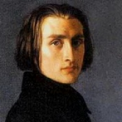
Liszt, Franz
Composer Information
Franz Liszt, T.O.S.F. (October 22, 1811 – July 31, 1886), in modern use Liszt Ferenc; from 1859 to 1867 officially Franz Ritter von Liszt, was a 19th-centuryHungarian composer, virtuoso pianist, conductor, teacher and Franciscan tertiary. Liszt gained renown in Europe during the early nineteenth century for his virtuosic skill as a pianist. He was said by his contemporaries to have been the most technically advanced pianist of his age, and in the 1840s he was considered by some to be perhaps the greatest pianist of all time. Liszt was also a well-known and influential composer, piano teacher and conductor. He was a benefactor to other composers, including Richard Wagner, Hector Berlioz, Camille Saint-Saëns, Edvard Grieg andAlexander Borodin. As a composer, Liszt was one of the most prominent representatives of the "Neudeutsche Schule" ("New German School"). He left behind an extensive and diverse body of work in which he influenced his forward-looking contemporaries and anticipated some 20th-century ideas and trends. Some of his most notable contributions were the invention of the symphonic poem, developing the concept of thematic transformation as part of his experiments in musical form and making radical departures in harmony. He also played an important role in popularizing a wide array of music by transcribing it for piano. [source from Wikipedia]
Work
- 2 Episodes from Lenau's Faust, S. 110
- Annees de pelerinage : Premiere annee Suisse -- Le mal du pays, S.160-R.10, A159 (Weekly Playlist 2015.11.27)
- Years of Pilgrimage - First Year: Switzerland, S. 160
- 6 Consolations, S. 172
- Poetic and Religious Harmonies III, S. 173
- Poetic and Religious Harmonies III, S. 173
- 2 Legends, S. 175
- Christmas Tree, S. 186
- Three Sonnets of Petrarch, S. 270
- Die Vatergruft, S. 281
- Oh! When I sleep, S. 282
- It must be a wonderful, S. 314
- The Three Gypsies, S. 320
- Flower and Fragrance, S. 324
- I lost my strength and my life, S. 327
- Your Bells of Marling, S. 328
- 19 Hungarian Rhapsodies, S. 244
- 19 Hungarian Rhapsodies, S. 244
- 19 Hungarian Rhapsodies, S. 244
- 19 Hungarian Rhapsodies, S. 244
- 19 Hungarian Rhapsodies, S. 244
- 6 Hungarian Rhapsodies, S. 359
- 12 Transcendental Etudes, S. 139
- 6 Transcendental Studies after Paganini, S. 140
- Grand Paganini Studies, S. 141
- 3 Concert Studies, S. 144
- Three Songs from William Tell, S. 292
- Mendelssohn Songs, S. 547
- 12 songs by Franz Schubert, S. 558
- Dedication, song by Robert Schumann, S. 566
- 19 Hungarian Rhapsodies, S. 244
- 19 Hungarian Rhapsodies, S. 244
- 19 Hungarian Rhapsodies, S. 244
- 6 Hungarian Rhapsodies, S. 359
- Symphonic Poem No. 6, S. 100 - Mazeppa
- Symphonic Poem No. 11, S. 105 - Hunnenschlacht
- Preludes, S. 97 (After Lamartine)
- Orpheus, S. 98
- Mephisto Waltz No.1, S. 514
- Waltz-Impromptu, S. 213
- Forgotten Waltzes, S. 215
- Evenings in Vienna, S. 427 (after Schubert)
- 2 Concert Studies, S. 145
- Years of Pilgrimage - Second Year: Italy, S. 161
- Years of Pilgrimage - Supplement: Venice and Naples, S. 162
- Fantasia on Hungarian Folk Melodies, S. 123
- Reminiscences of Don Juan, S. 418
- Fantasy on Themes from Mozart's Figaro and Don Giovanni, S. 697
- Reminiscences of Lucia di Lammermoor, S. 397
- Il Trovatore: Miserere, Concert Paraphrase S.433
- Concert Paraphrase on Rigoletto, S. 434 (After Verdi's opera)
- Ballade No. 1 in D flat major, S. 170
- Ballade No. 2 in B minor, S. 171
- In a dream, S. 207 - Nocturne
- Dreams of Love, S. 541
- Dance of the Dead, S. 126
- Csardas macabre, S. 224
- Piano Concerto No. 1 in E flat major, S. 124
- Piano Concerto No. 2 in A major, S. 125
- A Faust Symphony, S. 108
- Psalm 13, S. 13 (Sung in English)
- Years of Pilgrimage - Second Year: Italy, S. 161
- 3 Schubert Marches, S. 426
- Berceuse, S. 174
- 6 Polish Songs of Chopin, S. 480
- Piano Sonata in B minor, S.178