

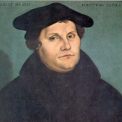
Luther, Martin
Martin Luther, OSA, (10 November 1483 – 18 February 1546) was a German friar, Catholic priest, professor of theology and seminal figure of the 16th-century movement in Christianityknown later as the Protestant Reformation. Initially an Augustinian friar, Luther came to reject several teachings and practices of the Roman Catholic Church. He strongly disputed the claim that freedom from God's punishment for sin could be purchased with money. He confronted indulgence salesman Johann Tetzel, a Dominican friar, with his Ninety-Five Theses in 1517. His refusal to retract all of his writings at the demand of Pope Leo X in 1520 and the Holy Roman Emperor Charles V at the Diet of Worms in 1521 resulted in his excommunication by the Pope and condemnation as an outlaw by the Emperor. In response to demands for a German liturgy, Luther wrote a German Mass, which he published in early 1526. He did not intend it as a replacement for his 1523 adaptation of the Latin Mass but as an alternative for the "simple people", a "public stimulation for people to believe and become Christians." Luther based his order on the Catholic service but omitted "everything that smacks of sacrifice"; and the Mass became a celebration where everyone received the wine as well as the bread. He retained the elevation of the host and chalice, while trappings such as the Mass vestments, altar, and candles were made optional, allowing freedom of ceremony. Some reformers, including followers of Huldrych Zwingli, considered Luther's service too papistic; and modern scholars note the conservatism of his alternative to the Catholic mass. Luther's service, however, included congregational singing of hymns and psalms in German, as well as of parts of the liturgy, including Luther's unison setting of the Creed. To reach the simple people and the young, Luther incorporated religious instruction into the weekday services in the form of the catechism. He also provided simplified versions of the baptism and marriage services. [source from Wikipedia]
All performances
Beethoven, Ludwig van